The platform
You open one thing, and it is already finished.
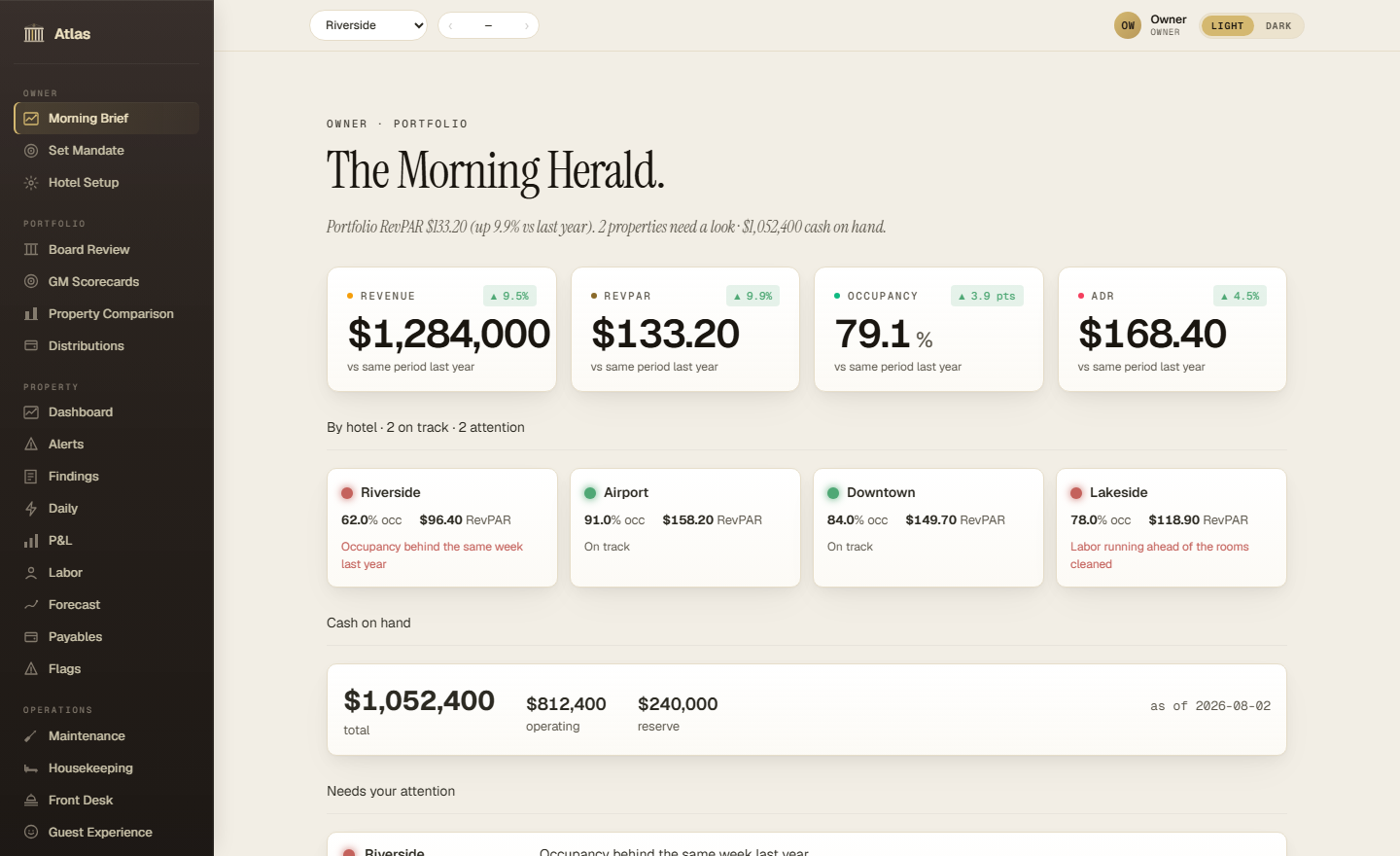
Every property in the same shape. Last night already written down. The read already made. You are not opening six things and building a picture out of them — you are opening one thing and finding the thinking done. One read, and you are current for the day.
Your morning now
The most valuable hour in a hotel currently goes to rebuilding yesterday.
One brand’s site for the first hotel, a different login for the second. Last night’s packet is in your email for one property and not the other, so you ask the front desk and then wait on it. The report somebody sends on Tuesday is already three days behind by the time you open it. None of it arrives in the same shape, so before you can compare anything you have to translate it first. By the time the building wakes up you have yesterday, and you have nothing to say about it. That is the trade you have been making every morning for years: the hour when you think best, spent on the one task that produces no thinking at all.
Waiting for you
What is waiting is a read, not a workload.
Not a screen full of accurate numbers that still needs an hour of you. A read. You start at the conclusions and spend your time deciding what to do about them.
01
Last night, in sentences
What the rooms did, what it cost to do it, and which of the two actually moved — written the way you would explain last night to someone over the phone, not the way a ledger would. It was written before you sat down. You are reading it, not making it.
02
Every property on the same page
All of your hotels side by side, in one shape, so you are comparing them instead of translating between them. Which one is doing the work this month and which one is being carried. Which one needs you this week and which one genuinely does not.
03
The month, while you can still change it
You know where the month stands on the eighth. If it is going the wrong way you find out with three weeks left to do something about it, instead of six weeks after it closed, when the only thing left to do is explain it.
04
What actually moved
Which cost moved, by how much, and whether it is a real change or a one-off that will not repeat. Whether a soft month is demand, cost, or both. Whether a good month is genuinely good or just seasonally good. That work is finished before you ever see it, so your first move of the day is a decision.
What leaves your day
A short list of things that quietly disappear from your morning.
The six logins
One brand’s site for one hotel, a different one for the next, then the mailbox to see whether last night’s packet turned up. All of it is in the one place you already have open, for every property, every morning. Chasing it stops being part of your job.
The sheet only you trust
You stop retyping other people’s numbers into your own workbook because your own arithmetic was the only version you ever fully believed. There is one version now, everyone is looking at it, and it is finished before you get there.
Checking before you use it
You stop checking the numbers before you use them. What is on the screen is what you act on. That single change hands back the half of the morning you currently spend proving to yourself that the first half was right.
Preparing for the call
You stop building a picture in case somebody asks for it, and you stop reshaping it into the format the owner likes. When the call comes, you are both already looking at the same thing.
Waiting on the month
The last week of the month stops being a holding pattern. You are not waiting to be told how it went — you have known since the second week, and you have already done whatever there was to do about it.
Approving, not entering
The bills come to you sorted and checked, and you stop only on the two that deserve a second look. Payroll is done — you look at it, you do not build it. Approving takes a few minutes at your desk instead of the back half of a Thursday.
What stops worrying you
Small problems stop getting expensive.
The costly problems in a hotel are never the dramatic ones. Something small goes slightly wrong in the second week, stays wrong for five weeks, and arrives at the close fully grown, with a price on it and a conversation attached.
You are not the last to know
The overtime that crept in on Saturdays. The invoice that got paid twice. The cost that went up in April and never came back down. You meet those in the morning, while they are still small and still cheap, instead of at month end with your name on them.
If something needs you, it finds you
You do not go looking, and you stop keeping a list in your head of the things you must remember to check. What needs a person comes and finds you. What does not need you stays out of your way.
The month is not a surprise
Nobody on the month-end call is hearing anything for the first time. You knew in the second week, your GM knew, and the accountant is confirming a month everyone in the room already lived rather than delivering one. The call gets shorter and more useful.
The conversation changes shape
You stop asking how we are doing and taking a feeling in return, unable to tell whether it is an honest one or a managed one. You ask about the thing that stood out to you, and the answer starts somewhere further along. That changes the relationship for good.
The hour when you think best, spent on the one task that produces no thinking at all.
The hour, back
The hour before anyone arrives finally belongs to you.
It stops going to yesterday and becomes the hour you actually run the business. The capital decision you have been carrying for a month without a clear head to give it. The property you have not physically stood in since February. An hour spent on next year instead of last night. Some mornings it is simply arriving at work without a backlog already in your head. The hour is yours to spend again, and it comes back every day.
Three seats, one Tuesday
The same quiet morning, wherever you sit.
You own it and you run it
Every property in one shape, and the reading done before you are awake. The scramble through extranets, mailboxes and your own private sheet is simply over, at every hotel, every day.
For owner-operators→You own it, not the operations
Before the school run, on your phone: how the asset did, how the month is tracking, and what the hotel can genuinely afford to pay you — without learning accounting, and without having to ask anyone for it.
For hands-off owners→You run the floor
Quarter to seven, lobby quiet, and there is nothing to assemble. Your first hour goes back into the building, and you are still ahead of the day at four in the afternoon.
For general managers→Proven first
Every morning on this page is a morning that already happens.
Somebody sat down to this exact morning today, and yesterday, and the Tuesday before that. A live, independently-operated hotel portfolio runs on it — owners, general managers, accounting staff and people on the floor, real money, real hotels. It had to work in their mornings before it was offered to anyone else’s.
Your next Tuesday
Your next Tuesday could be quiet.
Nothing about the way your hotels already run has to change to get there. No new system for your front desk, no new job for anyone on your staff, and nothing for anyone to key in twice.